Welcome to a site dedicated
to Afghan stamps and postal history. Inevitably the site is going to
take some time to grow . . and I've started with some of my favourite
areas . . . but I hope that in time will become a comprehensive first
stop for all things philatelically Afghan.
If you have any queries or comments, please contact me at afghanphilately@aol.com

Pre-stamp Pre-stamp mail from Afghanistan is scarce. Afghanistan did not
have an organised postal system until 1871. Before that date, mail was
carried either by– State Couriers (on behalf of the Amir); Government
Couriers (on behalf of high government officials); or Private
Messengers. Only one correspondence carried by private messenger is
believed to exist. This is a group of twelve letters sent to a
religious recluse named Sayyed Ali Abbas by his family. Abbas, who was
nicknamed Pir Lal Badshah or “Saint Red King”, had settled at
Sultanpur, a village near Dina in Jhelum District, India. His family
lived at Lalpura, a village on the Kabul river not far from the
Afghan/Indian border. Of the dozen surviving letters, which cover the
period 1869 to 1883, only two come from the period before the
introduction of the postal system. This example is the second of those
two and is dated in manuscript 14th October 1870. The distance from
Lalpura to Peshawar, where the letters were put into the Indian postal
system, is about 44 miles, but because of the mountainous terrain, the
journey by land usually took 3 days, with two overnight stops at
Landikotal and Jamrud. This series of covers however covered the
distance in either one or two days. The speed indicates that they were
carried by raft down the fast flowing Kabul river. Rafts were sometimes
made from timber, but usually from buffalo or goat skin. The letter is
dated in manuscript 14th October, and has the Peshawar City Receiving
House cancel of the same date, a Jhelum mark dated (1)5 (10) 70, and a
faint triangular postage due marking. This is also the earliest known
example of a Christian date being used on an Afghan cover and is
illustrated on page 22 of Uyehara and Dietrich, Afghan Philately.
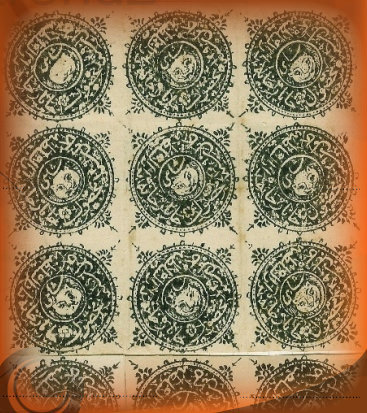
The 1868 Issue These "stamps" first appeared in 1890 when they were brought back from Afghanistan by a German, Captain Griesbach. He showed them to Thomas Tapling, then vice-president of the Royal Philatelic Society whose collection was later to form the basis of the British Library collection. On analysing the stamps and a few covers Tapling declared that "their history seems satisfactory" and that they were "an unknown and bona fide issue of Afghanistan" apparently pre-dating the first Afghan stamp by 4 years. Two examples remain in the Tapling Collection. Stanley Gibbons included the stamp in their 1891 Catalogue as Afghanistan number 1. Doubts were soon raised about their authenticity. The two foremost experts of the day - Masson and Jones - concluded that they were bogus. The characters were faulty, and the shape irregular indicating an illiterate engraver. All 21 examples examined were identical, indicating a handstamp (like the 1880 issue) rather than a lithograph stamp (like the 1871 issue). The design, paper and ink were also more similar to the 1880 issue than the 1871 issue. Stanley Gibbons eventually deleted the stamp from their catalogue in 1909, inserting instead a warning that it was bogus. This example has been (fraudulently) added to a letter dated 1289 (= 1872-73).
A page from Stanley Gibbons 1904 Catalogue showing the bogus 1868 issue as SG no. 1. NB Look at the price !!!